Frontier-scale representations bring the precision that contact-rich insertion needs: ScaleVLA aligns and inserts the plug where the 2B model misses the socket.
Sample efficiency
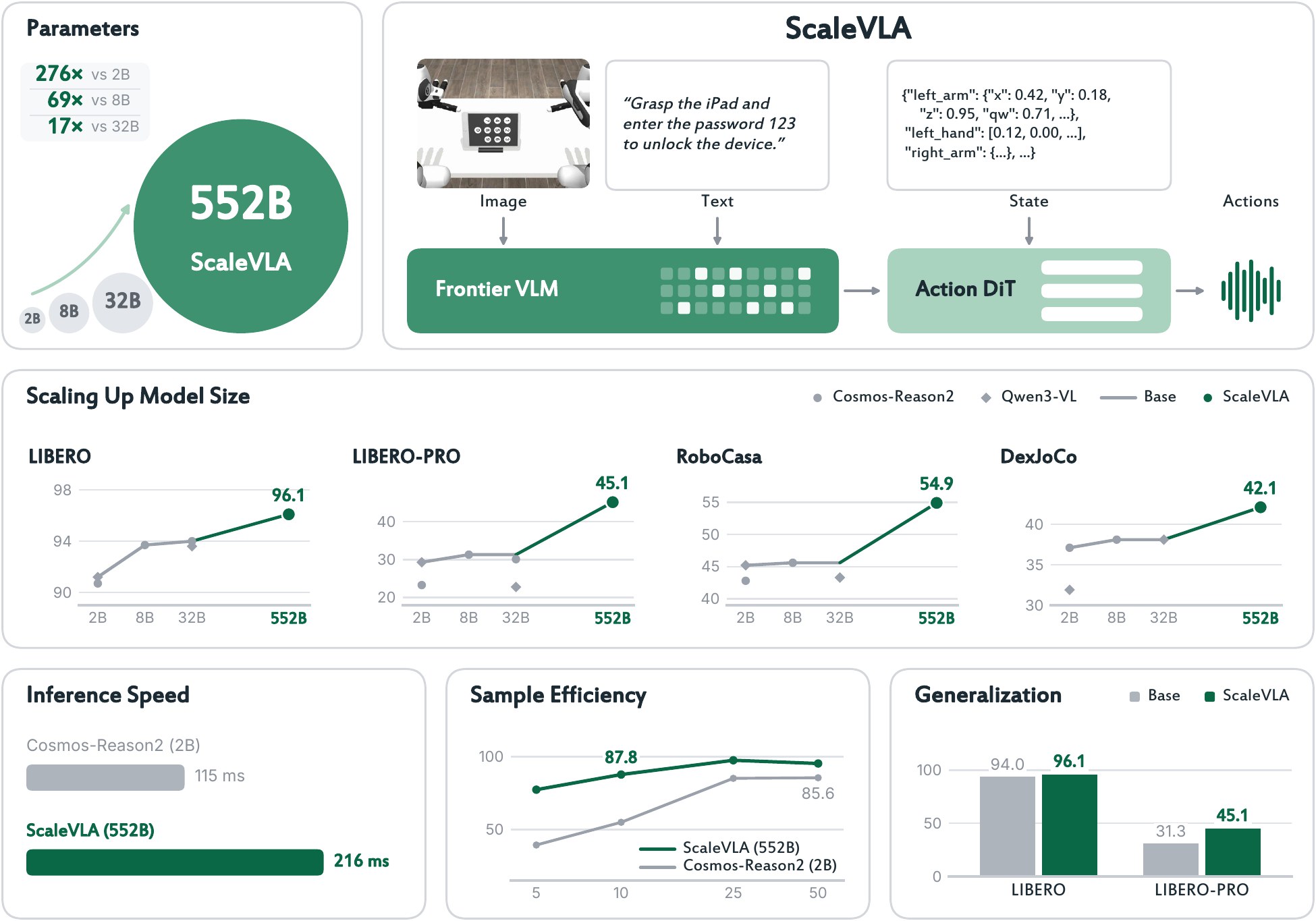
87.8%
LIBERO-Goal with 10 demos per task, vs 85.6% for a 2B backbone with 50.
Generalization
45.1%
LIBERO-PRO mean success, vs at most 31.3% for smaller backbones.
Precise manipulation
9/10
Real-robot charger insertion, vs 4/10 for Cosmos-Reason2-2B.
Latency
216 ms
Median per action chunk on RoboCasa, with 276× the parameters of a 2B backbone.
Can a frontier VLM be the foundation of a robot policy?
Frontier Vision-Language Models (VLMs) such as GPT-6 Astra have demonstrated remarkable capabilities in robot control, suggesting that broad pretraining provides knowledge valuable for physical action. Yet most Vision-Language-Action (VLA) policies still rely on much smaller VLM backbones, leaving this potential largely untapped. We ask whether frontier-scale representations can provide a stronger foundation for robot learning.
We introduce ScaleVLA, which connects a 552B DeepSeek-V4.1-Flash backbone to a trainable action DiT, scaling VLA models to 552 billion parameters. We evaluate three fundamental capabilities of robot foundation models. In sample efficiency, just 10 demonstrations outperform a 2B backbone trained with 50 (87.8% vs. 85.6%). In generalization, LIBERO-PRO success reaches 45.1%, compared with at most 31.3% for smaller backbones. In precise manipulation, real-world charger insertion improves from 4/10 to 9/10 successes, with gains concentrated in contact-sensitive alignment. Despite its scale, ScaleVLA achieves 216 ms median latency per action chunk.
Our findings suggest that frontier VLMs can serve not only as reasoning agents, but also as powerful representational foundations for efficient and generalizable robot policies.
1How It Works
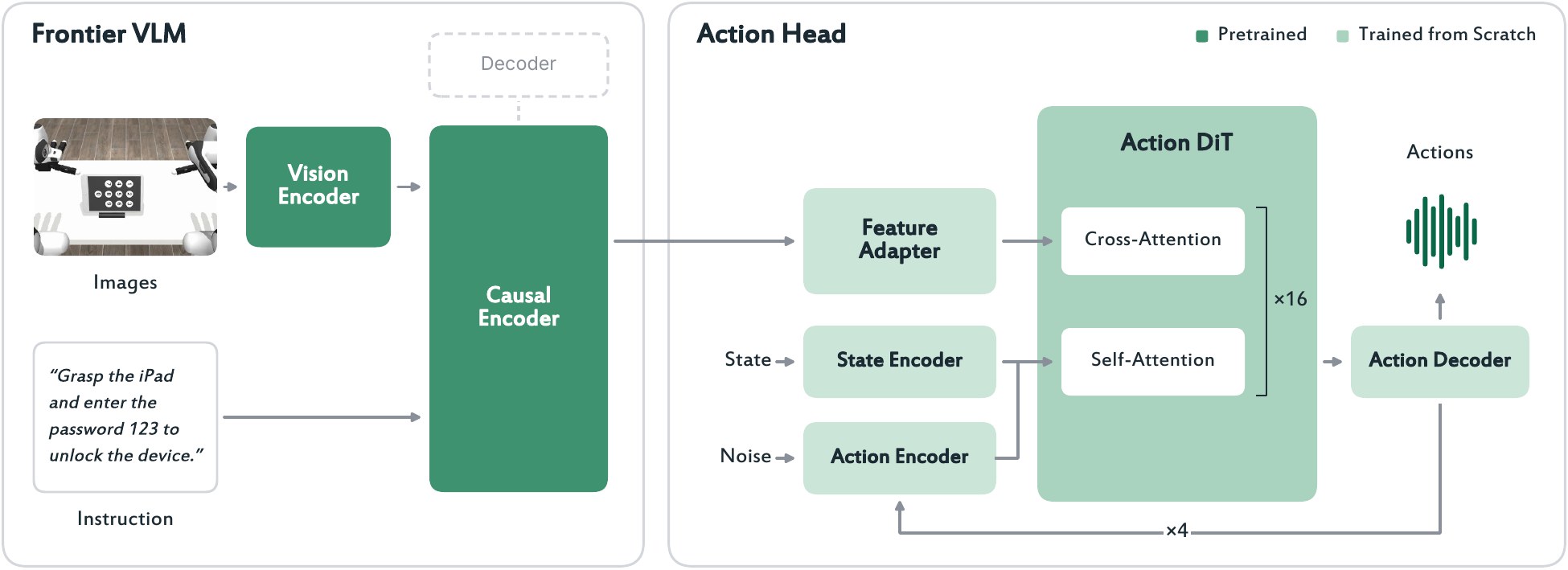
ScaleVLA does not reason in text. It reads the representations of a frontier vision-language backbone and maps them directly to continuous actions with a flow-matching action head trained from scratch.
Vision-language backbone
DeepSeek-V4.1-Flash-1017, a 552B mixture-of-experts model. We run its 20-layer causal encoder on the camera images and instruction and read every visual and text token (5120 dimensions). The decoder never runs.
Action head
A GR00T N1.7-style head: a feature adapter, state and action encoders, a 32-layer diffusion transformer that cross-attends to the backbone features, and an action decoder, all trained on robot demonstrations.
Why scale
Frontier-scale pretraining carries knowledge that transfers to physical action. At 552B, the backbone learns from fewer demonstrations, generalizes further and manipulates more precisely, while running at 216 ms per action chunk.
2Simulation Results
2.1Benchmarks
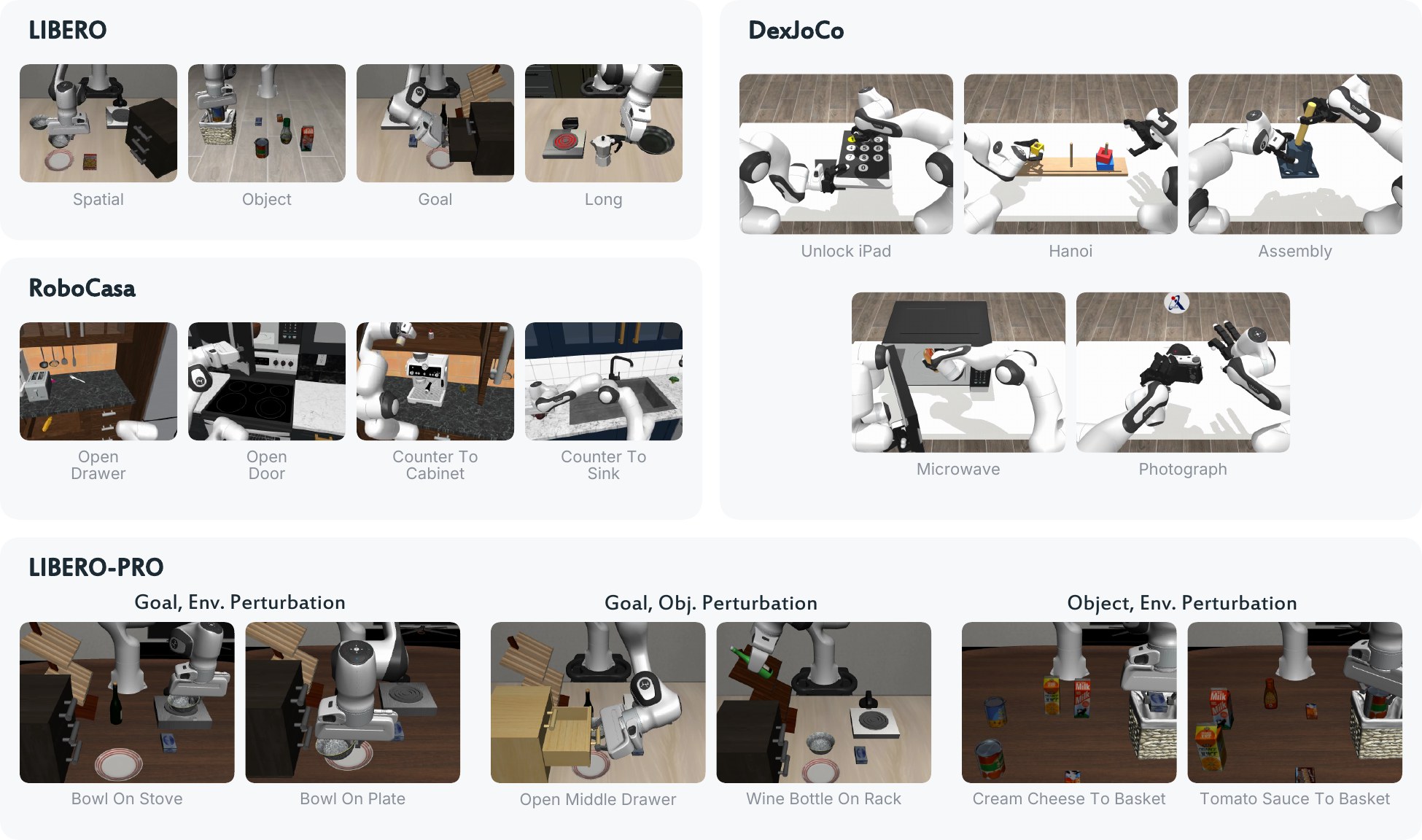
LIBERO tests tabletop manipulation, LIBERO-PRO perturbs its objects and scenes, RoboCasa tests kitchen tasks in out-of-distribution scenes, and DexJoCo tests five tasks that require coordinating two dexterous hands.
2.2Success Rates
Model
Spatial
Object
Goal
Long
Average
π0
96.8
98.8
95.8
85.2
94.2
OpenVLA
84.7
88.4
79.2
53.7
76.5
CoT-VLA
87.5
91.6
87.6
69.0
83.9
Qwen3-VL-2B
98.4
98.2
90.4
77.8
91.2
Cosmos-Reason2-2B
98.8
97.6
83.2
83.2
90.7
Cosmos-Reason2-8B
99.8
99.0
88.6
87.2
93.7
Qwen3-VL-32B
98.8
99.4
93.2
83.0
93.6
Cosmos-Reason2-32B
98.4
98.4
95.2
83.8
94.0
ScaleVLA (552B)
98.6
98.6
96.8
90.2
96.1
Success rates (%). The first three rows are published results. Our policies train on the full demonstration set of each suite.
Goal
Object
Backbone
Env.
Obj.
Env.
Mean
Qwen3-VL-2B
24.2
38.4
25.2
29.3
Cosmos-Reason2-2B
20.6
37.6
11.8
23.3
Cosmos-Reason2-8B
32.6
37.6
23.6
31.3
Qwen3-VL-32B
11.6
44.2
12.6
22.8
Cosmos-Reason2-32B
19.2
38.8
32.4
30.1
ScaleVLA (552B)
47.8
56.4
31.2
45.1
Success rates (%). The LIBERO policies are tested under environment (Env.) and object (Obj.) perturbations without retraining.
Backbone
Gen-30
Gen-100
Qwen3-VL-2B
22.4
45.2
Cosmos-Reason2-2B
23.2
42.8
Cosmos-Reason2-8B
25.6
45.6
Qwen3-VL-32B
25.5
43.3
ScaleVLA (552B)
30.7
54.9
Success rates (%) with 30 and 100 generated demonstrations per task, tested in out-of-distribution kitchens.
DP-T
π0.5
Qwen3-VL-2B
Cosmos-Reason2-2B
Cosmos-Reason2-8B
Qwen3-VL-32B
ScaleVLA (552B)
Task
Obj.
Obj.
Obj.
Full
Obj.
Full
Obj.
Full
Obj.
Full
Obj.
Full
Unlock iPad
0.0
0.0
17.3
8.7
15.3
4.7
26.7
6.0
26.7
14.0
31.3
15.3
Hanoi
8.0
4.7
11.3
8.7
24.0
4.7
24.0
13.3
24.0
10.7
28.0
14.0
Assembly
1.3
4.0
4.7
0.0
10.0
0.7
10.7
0.0
4.0
0.0
11.3
1.3
Microwave
42.7
34.7
84.7
61.3
81.3
62.7
82.0
62.0
89.3
62.7
73.3
67.3
Photograph
28.0
7.3
41.3
32.0
54.7
30.7
47.3
24.0
46.7
22.7
66.7
24.0
Average
16.0
10.1
31.9
22.1
37.1
20.7
38.1
21.1
38.1
22.0
42.1
24.4
Success rates (%). One policy per backbone learns all five bimanual tasks under object (Obj.) or full randomization. DP-T and π0.5 are published baselines.
2.3Generalization
We test the LIBERO policies, without retraining, under the environment and object perturbations of LIBERO-PRO, which check whether a policy holds up outside its training conditions. Every policy drops sharply, but ScaleVLA retains the most: its mean success of 45.1% is about 14 points above the best dense backbone and well above the 23.3–29.3% of the 2B backbones, and it leads under both Goal-suite perturbations. Frontier representations therefore transfer better beyond the training distribution.
Below, rollouts of the 2B backbone and ScaleVLA under LIBERO-PRO perturbations. Full results are in the LIBERO-PRO table above.
3Real-Robot Experiments
3.1Plug In Charger
In the Plug In Charger task from RoboDojo, the right arm grasps a phone charger and hands it over, and the left arm aligns the plug with a power-strip socket, inserts it and releases it. The policies observe a head camera and two wrist cameras on a bimanual ARX X5.
Cosmos-Reason2-2B + Action Head✕
4×
π0.5 + Action Head✕
4×
ScaleVLA (552B)✓
4×
Head cameraLeft wristRight wrist
All three policies reach the socket; only ScaleVLA inserts the plug.
3.2Success Rates and Timing
Successes
In-domain, median (s)
Latency
Policy
In-domain
OOD
Insertion
Completion
(ms)
Cosmos-Reason2-2B + Action Head
4/10
5/15
85.9
147.1
311
π0.5 + Action Head
8/10
7/15
81.2
132.0
262
ScaleVLA (552B)
9/10
8/15
58.1
114.4
384
Ten in-domain and fifteen out-of-distribution (OOD) trials per policy. Times are medians over successful in-domain trials; latency is the median round trip per action chunk at the robot client.
3.3More Trials
4×
Head cameraLeft wristRight wrist
4Efficiency
4.1Sample Efficiency
We vary the number of demonstrations per task, N ∈ {5, 10, 25, 50}, on LIBERO Goal and Long. ScaleVLA consistently outperforms smaller backbones in low-data regimes, with the most pronounced gains when demonstrations are scarce. With only five demonstrations per task, scaling the backbone from 2B to 552B nearly doubles the success rate on LIBERO-Goal, from 39.4% to 77.4%. ScaleVLA needs only 1/5 of the demonstrations to surpass the 2B backbone on LIBERO-Goal (87.8% with 10 vs 85.6% with 50).
Goal
Long
Demos per task
2B
8B
32B
552B
2B
8B
32B
552B
5
39.4
60.6
61.2
77.4
24.0
40.0
37.6
62.2
10
55.0
70.0
83.0
87.8
56.0
65.2
66.4
75.0
25
85.2
83.0
90.4
97.6
69.6
65.6
83.6
84.6
50
85.6
88.6
95.2
95.4
82.4
87.2
83.8
86.8
LIBERO success rates (%) with N demonstrations per task. The 2B, 8B and 32B backbones are Cosmos-Reason2 models; 552B is ScaleVLA.
4.2Inference Latency
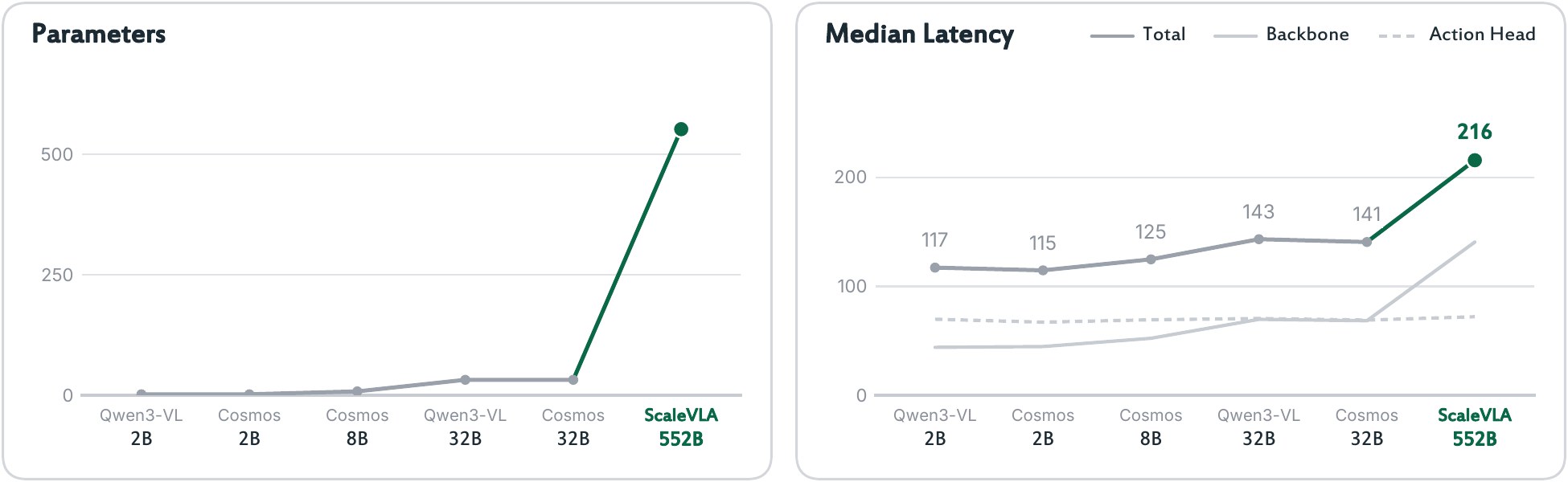
The sparse mixture-of-experts backbone activates only a subset of its experts per token, and the causal encoder runs once per action chunk. With four H200 GPUs, ScaleVLA keeps latency in the hundreds of milliseconds per chunk: 276× the parameters of Cosmos-Reason2-2B at 1.9× its median latency per action chunk.
Median latency on RoboCasa (ms)
Backbone
GPUs
Tokens
Backbone
Action head
Total
Qwen3-VL-2B
1
212
44.0
69.8
117.2
Cosmos-Reason2-2B
1
212
44.7
67.1
114.7
Cosmos-Reason2-8B
1
212
52.3
69.3
124.8
Qwen3-VL-32B
1
212
69.7
70.5
143.3
Cosmos-Reason2-32B
1
212
68.4
69.0
140.7
ScaleVLA (552B)
4
568
140.7
72.1
215.8
Medians per action chunk on H200 GPUs.
BibTeX
@article{yu2026scalevla,
  title   = {ScaleVLA: Scaling Vision-Language-Action Models to 552 Billion Parameters},
  author  = {Yu, Ruixi and Liu, Dairu and Chen, Xuchuan and Qi, Zekun and Li, Zekai and Cao, Zhuo
             and Niu, Luyang and Zhang, Yingsheng and Liang, Sikai and Fan, Ke and Wang, He and Yi, Li},
  journal = {arXiv preprint arXiv:2611.21607},
  year    = {2026},
  url     = {https://arxiv.org/abs/2611.21607}
}